For the next few weeks, Theologian Thursday is going to highlight the Cappadocian Fathers (and sister Macrina)--perhaps the most important Greek influence in church history. I'm pretty excited about it, because I love rediscovering pre-schism Christian thought--eastern ideas that were lost and have been lacking in the western church. It really helps develop a fuller, more rounded theology.
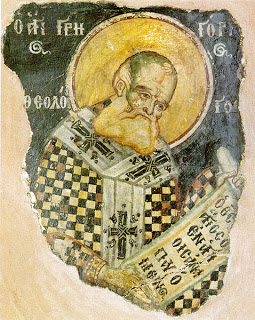
Gregory of Nazianzus was an acetic monk at heart, but after traveling and studying extensively spent a good deal of his life in the priesthood and public ministry--mostly due to the prodding of his father and his friend Basil the Great. He became the bishop of Constantinople, the goal of this position being to rid the church of Arian and Apollinarian heresies.
His life work was upholding Nicene orthodoxy, as well as developing an orthodox theology of the Trinity and a fleshed-out pneumatology. Gregory is usually credited with the formation of the idea of "procession" of the Holy Spirit--that it proceeds from both the Father and the Son, and yet, since Father and Son are one, that which proceeds from them is also one with them (I know, crazy stuff, right?). I'll probably discuss more about his trinitarian thought and the "social" trinity in later Cappadocian posts--it was kind of a team effort.
What you should read:
(To read more about my rating system, click HERE.)
Gender Equality:
Gregory is another of the super-early Church Fathers, so it's hardly fair to rate him here. But since he was one of the Cappadocian Fathers, I imagine he did get some influence from Macrina (about whom I'll post later), so surely he had a little respect for the ideas of women.
Environmental Sensibility:
I think Gregory was much more concerned with spiritual issues than those regarding creation. However, one could interpret his belief about Christ's assuming humanity for the purpose of its redemption to be assuming creation as a whole.
Heretical Tendencies:
Super orthodox. He lived and breathed the Nicene Creed. And while the western church may have shelved his ideas, I think it's definitely safe to say he's nowhere near heresy.
General Badassery:
Gregory was pretty tame. He spoke harshly against Arians, but that's to be expected from such an orthodox bishop. I'm more convinced of his character by the fact that, though he wasn't really interested in being a high-profile church leader, and would rather live the monastic life, he basically did as he was told by those around him. He's also the least-well-known of the Cappadocians. Pretty vanilla, I'd say. But of course that doesn't make his work any less important!
And lastly, a quote:
"That which was not assumed is not redeemed; but that which is united to God is saved."
(image from here)
Gregory of Nazianzus was an acetic monk at heart, but after traveling and studying extensively spent a good deal of his life in the priesthood and public ministry--mostly due to the prodding of his father and his friend Basil the Great. He became the bishop of Constantinople, the goal of this position being to rid the church of Arian and Apollinarian heresies.
His life work was upholding Nicene orthodoxy, as well as developing an orthodox theology of the Trinity and a fleshed-out pneumatology. Gregory is usually credited with the formation of the idea of "procession" of the Holy Spirit--that it proceeds from both the Father and the Son, and yet, since Father and Son are one, that which proceeds from them is also one with them (I know, crazy stuff, right?). I'll probably discuss more about his trinitarian thought and the "social" trinity in later Cappadocian posts--it was kind of a team effort.
What you should read:
- Fifth Theological Oration: On the Holy Spirit
- Concerning the Unity of God/Concerning Heresies
- He actually has lectures on each part of the Nicene Creed
- The Kenosis of the Son
(To read more about my rating system, click HERE.)
Gender Equality:
Gregory is another of the super-early Church Fathers, so it's hardly fair to rate him here. But since he was one of the Cappadocian Fathers, I imagine he did get some influence from Macrina (about whom I'll post later), so surely he had a little respect for the ideas of women.
Environmental Sensibility:
I think Gregory was much more concerned with spiritual issues than those regarding creation. However, one could interpret his belief about Christ's assuming humanity for the purpose of its redemption to be assuming creation as a whole.
Heretical Tendencies:
Super orthodox. He lived and breathed the Nicene Creed. And while the western church may have shelved his ideas, I think it's definitely safe to say he's nowhere near heresy.
General Badassery:
Gregory was pretty tame. He spoke harshly against Arians, but that's to be expected from such an orthodox bishop. I'm more convinced of his character by the fact that, though he wasn't really interested in being a high-profile church leader, and would rather live the monastic life, he basically did as he was told by those around him. He's also the least-well-known of the Cappadocians. Pretty vanilla, I'd say. But of course that doesn't make his work any less important!
And lastly, a quote:
"That which was not assumed is not redeemed; but that which is united to God is saved."