Christmas music has been on heavy rotation around these parts, pretty much since Thanksgiving was over. Records spinning at home, Sufjan Stevens at work, 24/7 Christmas radio in the car. So I thought I'd share a couple of my favorite Advent/Christmas hymns.
I love hymns in general, but I really like Christmas hymns. I think that's because there's so much crappy/cheesy/awful Christmas music. So when you find the good ones it's like treasure.
My #1 favorite is "Hark the Herald Angels Sing." It was written by Charles Wesley and is theologically so spot-on. Like, there are some hymns and church songs that I like, but have to kind of cringe through because of their eschatology or christology or gendered pronouns, but NOT THIS ONE. This hymn has like fist-pumping in the pews theology. Love it.
"Come Thou Long Expected Jesus" is another good one. Also by Charles Wesley.
What are your favorite Christmas songs or hymns? And what makes a good one, anyway? Please share in the comments!
I've been done with all my coursework for this quarter for a couple of weeks. So now that I've had some time to reflect, here's a bit of a wrap-up.
Strategic Management of Social Media
I enjoyed this class, for the most part. I'm pretty adept at social media, simply because I've been using it for so long. But this class taught me how to think of it more strategically and business-mindedly. It wasn't totally library-related, but there were certainly ideas that translate, and I think it gave me a good, solid perspective on how to use social media professionally. I learned how to use social media well, how to set and achieve social media goals, and how to get a good ROI.
The book we focused on was The Dragonfly Effectby Jennifer Aaker and Andy Smith, and it laid the process out and made successful use of social media seem really simple and doable.
Research Methods
This class was kind of a wreck. I got an A in it, but between the FIVE different professors and lecturers who did not communicate with each other and gave us conflicting instructions and information, frustrating group projects which didn't seem to line up with the course material, and boring-as-dirt readings, any redeeming qualities were entirely lost.
Not to mention I am not interested in social scientific research at all to begin with. I tried to have a good attitude about this class, but it really didn't do itself any favors.
I'm about halfway through the program now, and honestly I can't wait for it to be over.
Yes, I'm learning things. Yes, I still want to be a librarian.
The new phone books are here! The new phone books are here! Not really, but I am in print! I may have mentioned that I was putting together a bibliography of sorts for Geez Magazine's "Worship and Anarchy" issue. My piece isn't available online, so I'll post it here. But if you want a hard copy--and you really should, it's a great issue!--you can order one HERE.
These are books I'd recommend if you are interested in learning more about Christian anarchism. Any of them would be a great starting place if you're just looking into it, or a place to dig a bit deeper.
Let me know what you think. Have you read these? What would you add to the list?
The Kingdom of God is Within You (1894)
by Leo Tolstoy
This classic has influenced anarchists and nonviolent resisters from Ammon Hennacy to Gandhi and
Martin Luther King, Jr., and is an enduring cornerstone of the anarchist
canon.
A short, accessible argument for Christian
anarchism, directed at both anarchist and Christian skeptics. Ellul
challenges the involvement of the church
in the politics of the nation-state and encourages the reader to imagine a
more Christ-like alternative.
Also recommended: Violence and The Subversion of
Christianity
Anarchism and Other Essays (1910)by Emma Goldman
Reading
Goldman, a committed atheist who sometimes supported violence, is important
for giving shape to an anarchistic worldview. Plus, she’s a formidable early
anarcha-feminist you want to know about.
This autobiography gives us a glimpse into what a life shaped by
Christian anarchism looks like. Day, who created the Catholic Worker anarchist
newspaper and founded Hospitality Houses that fed and clothed the poor, had a
passion for “making the world a place where people can be better human
beings.”
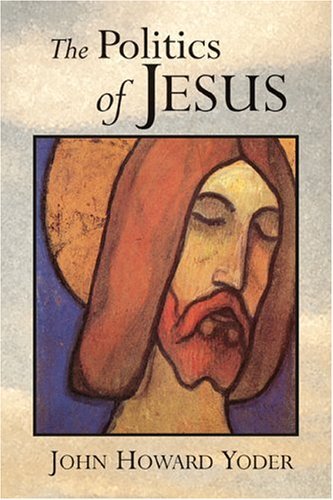
The Politics of Jesus (1972)by John Howard Yoder
Yoder,
an anabaptist theologian who has been influential for Christian anarchists,
takes Jesus as a “model of radical political action.” He shows how the Jesus
of Christendom hardly resembles the Jesus of the gospels. Truly following
Jesus should change our social ethic to the countercultural ethic of the Beatitudes
and Jubilee.
Living on Hope
While Living in Babylon (2009)by Tripp York
In York’s
analysis, the Christian anarchist politic is apocalyptic rather than
apolitical. He shows how it has been lived out by well-known
anarchists like Dorothy Day and Clarence Jordan. The tone is hopeful: York
presents a Christian anarchist way of life as not only viable but even
fruitful.
The Myth of a Christian
Nation (2007)
by Gregory Boyd
Boyd tackles the creeping
problem of Christian patriotism in the United States and challenges believers
to rethink the way they engage in politics instead of buying
into the evangelical myth of the religious right.
Resident Aliens (1989)by Stanley Hauerwas and William
Willimon
This book isn’t explicitly
anarchist, but it challenges Christians to think critically about our cultural contexts and how to live as a colony
of believers – in the world and yet not of the world.
Waging
Nonviolent Struggle (2005) by Gene Sharp
Sharp is
neither overtly anarchist nor Christian, but he offers a “social view of
power” – that power comes from the people and is dependent on their
cooperation. He advocates for nonviolence as an effective means for oppressed
people to create change and lists 198 different methods of nonviolent action.
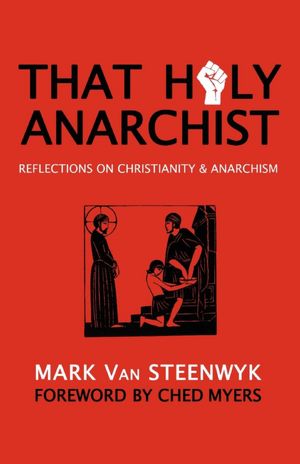
That Holy
Anarchist (2012)
Mark Van Steenwyk
A quick read that covers
the basics of Christian anarchism as well as its most common challenges. Van
Steenwyk provides a very accessible and informative primer on the anarchistic
leanings of Jesus.
Jesus For President (2008)
Shane Claiborne and Chris
Haw
Designed in
full colour with a DIY aesthetic, this book uses the stories
of ancient Israel and the early church to frame the way Christians may think
about government and rulers today.
Oppression and Liberty (1955)
by Simone Weil
Simone Weil was an
anarchist-turned-Catholic mystic. A well-educated
early-twentieth-century woman, she offers a unique, thorough and
philosophical perspective on power and politics, and a particularly
apt criticism of Marx.
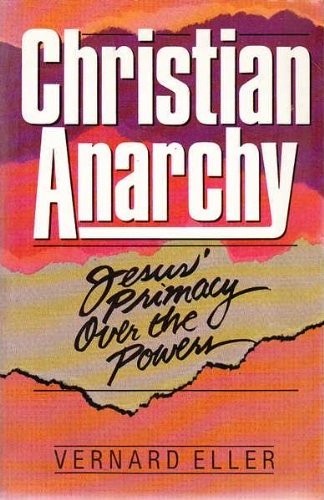
Christian Anarchy (1987)
by Vernard
Eller
In a
scholarly yet informal style, Eller provides many “whys” of Christian
anarchy, explaining how kingdom of God “arky” is so different from wordly
“arkys” and therefore how Christians should think and live differently.
Christian
Anarchism: A Political Commentary on the Gospel(2010) byAlexandre Christoyannopoulos
With
accessible academic style, Christoyannopoulos presents an extensively
researched and thorough study of Christian anarchism that includes its
origins and history, prominent leaders and influencers, and biblical and
theological supporting theories.
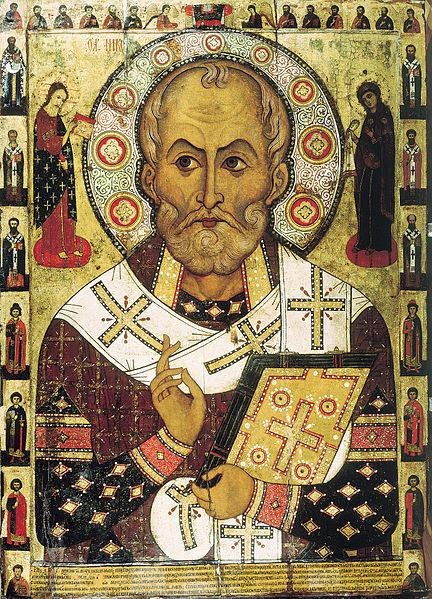
Since today is the feast day of Saint Nicholas, and his name is often invoked this time of year, I thought it would be appropriate to dedicate today's post to him.
As you might imagine, the larger-than-life legendary quality of Saint Nicholas far exceeds his actual story.
I mean, he was certainly a generous man, a pious bishop, and holy enough to become a saint. But honestly, how a modest and charitable person can become the well-known (yet not really known at all), commercialized caricature that we think of Saint Nicholas astounds me.
Anyway, the best known story of Saint Nicholas is that he caught wind of a man who had three daughters whom he could not marry off because he had not enough money for a dowry, so he was going to send them off to be prostitutes. Saint Nicholas, being well-off due to the inheritance of his parents, wanted to help. And so, under cover of darkness (for he was a humble man), he tossed bags of money through the windows of the man's home, resulting in the oldest daughter's marriage. He did the same for the other two daughters in subsequent years.
That's it, people. That's why Santa Claus delivers presents at night. And it's completely possible that this story is made up.
The funnier thing about this story is that it's the reason that, in paintings, Saint Nicholas is often portrayed with three moneybags, which somewhere along the line someone thought were the heads of three children. Thus leading to a legend about his resurrection and healing of three children who had been beheaded AND PICKLED by an evil innkeeper. For real. Who comes up with this stuff?
Saint Nicholas's main miracle was that he appeared in a dream to the emperor Constantine and his aide, telling them to release three innocent prisoners, who had prayed in Nicholas's name to be saved. The next morning, Constantine let them go free, instructing them to go to Bishop Nicholas and tell him to stay out of his dreams.
Nicholas may or may not have been present at the Council of Nicaea in 325, but one account that says he was indeed there includes that he slapped Arius across the face. Which I'm sure most people there wish they could have done.
A 2005 forensic investigation of Saint Nicholas's bones, which were quite well-preserved in his crypt in Bari, Italy, revealed that he was only about five feet tall. Which gives new meaning to the song "Little Saint Nick."
Today is the first day of Advent, which means it is the first day of the Christian calendar.
Happy New Year!
I am looking forward to this season of anticipation and meditation on the incarnation, and I hope you are too!
This evening I'll be participating in an advent dinner at my church, so I hope to write a bit more about that and how it goes this week. I think it will be a very special time. There is so much about this season that is contrary to the busy-ness and harried-ness of this time of year, and it's fascinating to try and hold the patience and waiting in tension with the go-go, gimme-gimme tendencies we all experience.