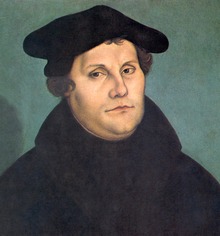
Theologian Thursday: Martin Luther (1483-1546)


I have held out on doing Martin Luther for the longest time. Mostly because I pretty much don't like the guy or his theology and didn't feel like I could give him a fair shake, but then I realized it's my blog and I can do whatever I want, so there.

But before this post becomes 500 Reasons Martin Luther is a Turd, here are some things I like about him:

  1. He is The Reformer of the Western Church. As I mentioned in my post on Reformation Day, despite my Catholic sympathies, I am irrevocably Protestant. So I have him to thank for that. He stood up to many ills in both belief and praxis in the Roman Catholic Church (i.e. selling indulgences--basically allowing people to buy forgiveness for their sins from the church).
  2. I'm a fan of his doctrine of the sacramental union and real presence of Jesus Christ in the Eucharist. I feel like it's a nice middle road between Zwingli's merely memorial elements (not real or important enough, if you ask me) and traditional transubstantiation (maybe too real?) and it acknowledges that the bread and wine is the body and blood of Christ (not just a symbol)... but that it's still bread and wine so don't freak out. Anyway, I could talk about Eucharist forever so I'll leave it at that.
  3. He's cool with clerical marriage. His own marriage set the precedent for Protestant priests, pastors, etc. to marry, which I think is right and good.
  4. "Soul sleep." Obviously nobody knows what happens when people die. But I know enough about biology (and, I don't know, astronomy, I guess?) to say that our "souls" probably don't "go to heaven," because A) There's not really a soul and B) There's not really a heaven. But because I'm a Christian and believe (or really, really want to believe) in a resurrection of the dead (kind of... maybe... sorry, there's no way to get through this paragraph without a million qualifications), I think the idea of "soul sleep" kind of makes the most sense. When you're dead, you're dead. But then you'll be alive again. Hopefully.
So those are some cool things about Luther.

I could make another list about how he was anti-semitic, hated women, put too much stock in the epistles of Paul/pseudo-Paul, thought each Christian had to "tear the eyes out of his Reason," had a wonky translation of the Bible, believed in "just" war, and was on the wrong end of a debate with my beloved Erasmus... but this sentence will have to do. I like to keep things positive around here.

What you should read:
  • Word and Sacrament I-IV (good stuff to be found in here)
Ratings:
(To read more about my rating system, click HERE.)
Gender Equality: 
I'll let Luther speak for himself here: "Men have broad and large chests, and small narrow hips, and more understanding than women, who have but small and narrow breasts, and broad hips, to the end they should remain at home, sit still, keep house, and bear and bring up children." "Tis you women, with your tricks and artifices, that lead men into error""The word and works of God is quite clear, that women were made either to be wives or prostitutes."

Environmental Sensibility: 
Again, it's hard to say. He has some nice thoughts about natural theology, but I feel like he'd be the type of person that wouldn't be much of a tree-hugger.

Heretical Tendencies: 
Obviously this depends on the side of the Catholic/Protestant divide on which you stand. Luther was excommunicated for not recanting anything from his works, especially the 95 theses. But much of his thinking is still pretty mainstream within Protestantism.

General Badassery: 
I can't deny that Martin Luther was a total badass. I mean, anyone who can just come out and say that the Bible says women are only fit for sex (for babies or business) has some major cojones. Dude was big and loud and drank and did and said pretty much whatever he wanted., without caring who was listening or what they would think (even if it was the Pope). I can dig that.


Lastly, a lovely quote:
"Our Lord has written the promise of resurrection, not in books, but in every leaf in springtime."

Regrouping

Between the holidays and vacation, my blogging schedule has gone all wacky.

So apologies to those of you who have missed Theologian Thursday (I was surprised to actually get complaints about missing it!).

Things should be getting back to normal this week.

Look forward to

  • Theologian Thursday (I'm always open to suggestions if you have someone in mind! Leave a comment!)
  • Winter Quarter first impressions. Classes start this week. I'll be taking Management of Information Organizations and XML Information Structures. (Fingers crossed this quarter's better than last.)
  • The return of Caturday!

Jonathan Edwards and New Year's Resolutions


New Year's resolutions inevitably remind me of Jonathan Edwards.

Dude was intense.

He outlined 70 Resolutions to guide him in becoming a better, more holy person.

And even though, as a good Wesleyan, the "Sinners in the Hands of an Angry God" preacher Jonathan Edwards is probably one of the last people I'd choose as a life coach, some of these Resolutions really resonate with me. 

Here are some of my favorites:

  • Resolved, that I will live so as I shall wish I had done when I come to die.
  • Resolved, always to do what I can towards making, maintaining and establishing peace
  • Let there be something of benevolence, in all that I speak.
  • Resolved, never to suffer the least motions of anger to irrational beings. (This one would definitely come in handy when reading Facebook and blog comments...)
I appreciate that, instead of just saying "Be perfect," or "Don't screw up," he created seventy line items of ways to do that. And he committed to re-read them every week to remind himself of his goals. I'm a hugely goal-oriented person--I love the whole process of setting goals and the satisfaction of achieving them--and it's so important to make them realistic, manageable, and focused. 

I don't have a complete list for the year drafted, but some of my new year's goals include getting another piece published, doing more book reviews, and saving money for a house. Who knows, maybe I'll even try to read Jonathan Edwards's Resolutions every week too.

What are some of your goals for 2013?

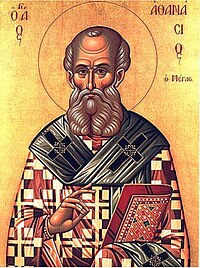
Theologian Thursday: Athanasius (296-373)


As Christmas inches ever closer (less than a week away, now!), I find myself constantly swept up in the miracle and mystery of the incarnation. It is, in my opinion, the defining aspect of our faith and the key part of the salvific narrative.

So as I was reading Athanasius's On the Incarnation, I realized he had not had his own Theologian Thursday post yet! So here we are.

Athanasius was the bishop of Alexandria, and is most well known for his opposition to the Arian heresy and his role at the councils of Nicaea (325) and Alexandria (326).

The gist of the story is that Arius was teaching a subordinationist christology (i.e. that the second Person of the Trinity was created in time, rather than begotten eternally), which had actually taken off and become quite popular. In fact, this may be the only historical heresy with an accompanying jingle--people were going around singing, "There was a time when the Son was not." Athanasius challenged Arius, asserting that the Son could not have been created, because then it would be creature and not divine.

Then he got Arius anathemized.

Athanasius was not without his own problems though. He was sent into exile a couple times, mostly because emperors were mad about the Arius thing. This was right after Constantine adopted Christianity and the Church began to be entangled with the Empire, so clergy had become more political. Athanasius did most of his writing while in exile.

What you should read:
Ratings:(To read more about my rating system, click HERE.)
Gender Equality: I don't think I would call Athanasius a total misogynist, but he does pen some questionable lines about women and sin, and the necessity of the virginity of Mary. Plus, there's not much to say that he actually appreciated women. 
Environmental Sensibility: The fourth century was certainly not a time of much interest in the environment. And yet, these early fathers were not destroying the earth as humanity came to do later either, so I suppose there was less to worry about.
Heretical Tendencies: 
Athanasius's fight was for orthodoxy, and his christology and view of the Trinity is still considered orthodox today. Interesting how a "winner" in a doctrinal debate automatically becomes 100% orthodox, while the other is 100% heretical and has his work burned.

General Badassery: 
I was actually surprised to find Athanasius to be a lot less badass than I was expecting. Besides the anathemizing and exiles and writing, his life was not really a big deal. He died peacefully in his home at a very old age. Oh, and his nickname was the "Black Dwarf," which is not so much badass as it is politically incorrect.


Finally, a classic quote:

"The Son of God became man so that we might become God."